








Throughout 2026 I have been exploring early Sabbatarian Adventists in the states that now comprise the Mid-America Union. There is no way to know who the first Millerite or Adventist was in each state. Instead, I have attempted to feature the first people to write to the Advent Review and Sabbath Herald (forerunner of the Adventist Review) from the territories or states in what is now the Mid-America Union. However, the first Adventists to visit Wyoming, were merely traveling through. There are hints that small groups and isolated Adventist families lived in Wyoming before anyone wrote to the Review in the 1890s.
The first Adventists to visit Wyoming were those traveling through on the Union Pacific Railroad, headed to destinations on the West Coast. It must have felt like an empty country. In 1870, the Federal Census counted less than 10,000 residents (excluding Native Americans living on reservations who were not counted).
James White mentioned passing through Cheyenne, Wyoming Territory, several times on the Whites’ transcontinental travels. In 1873 as James and Ellen White left Colorado, Cheyenne was the site of their decision to return to Battle Creek for the General Conference session instead of continuing on to California as originally planned (Advent Review and Sabbath Herald). Others also mentioned passing through Cheyenne on the railroad, but none of them indicated making contact with residents or even leaving literature. However, some Adventists must have made their way to Wyoming to stay, because the General Conference reported seventy church members in the Wyoming Mission in November 1879 (Advent Review and Sabbath Herald).
Scouring the pages of the Advent Review and Sabbath Herald suggests the potential identity of only one of these seventy church members: In 1881 Mary T. Joynson of Rawlins, Wyoming Territory submitted a classified seeking the location of Eugene Fowler, probably her oldest son, Alfred E. Fowler. Mary Joynson joined the Adventist Church in Minnesota in 1862 with her first husband Stephen T. Fowler (1827-1875). After his death she married Samuel Joynson, and by 1880 they lived in Rawlins, Wyoming.
By 1880, Wyoming’s counted population had doubled to 20,789. Based on growth between 1880 and 1890, there were 33,000-40,000 people in Wyoming in 1883 when the General Conference assigned Wyoming Territory to the Colorado Conference. It then became the responsibility of Adventists in Colorado to begin outreach. Work began with the Wyoming Tract and Missionary Society.
That same year, extracts of letters from a Baptist lady in Wyoming Territory, who converted after reading Adventist literature and whose name was not shared with readers, were printed in the Review. It was obvious that she was both reading and sharing with others a quantity of Adventist literature (Adventist Review and Sabbath Herald).
First Wyoming Tract and Missionary Society Agent
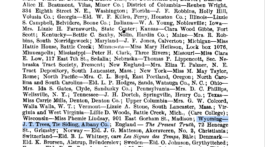
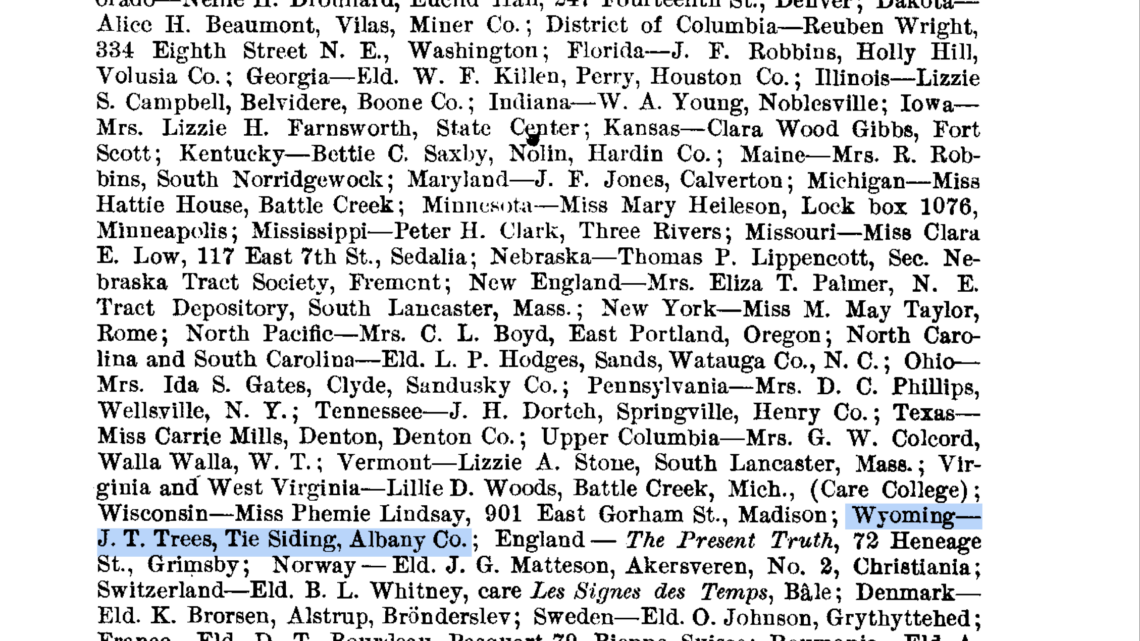
According to the Seventh-day Adventist Yearbook, Jacob Thornton Trees was the first agent in Wyoming for the Tract and Missionary Society, appointed in 1885, or perhaps even 1884. He held the office until at least 1886, possibly as long as 1888 (Seventh-day Adventist Yearbook, 1885).
Jacob Thornton Trees* was born February 13, 1853, in Illinois. He was the youngest of six children, and his father, Jacob W. Trees, apparently died before Jacob Thornton was seven years old. By then the family had returned to Jackson County, Indiana—his mother Eliza Robertson Trees’ home. Eliza raised her children in Indiana. Several of the children married in Indiana before the siblings began a staggered migration to Albany County, Wyoming. Their mother eventually joined them as well.
Where Jacob Thornton Trees met and married Mary Jane Brown (1861-1946, born in Arkansas) is unknown, but it seems likely they met in Colorado or Wyoming, or at least on their way west. In 1880, the couple was living in Dale Creek, Albany County, Wyoming (about 20 miles southwest of Laramie), with their three-month-old daughter and two of Jacob’s siblings. Despite the proximity to Laramie, the family floated between Dale Creek and northern Colorado. In 1883 their second daughter was born Colorado. Shortly after, probably in 1884, they joined the Seventh-day Adventist Church likely in Fort Collins, although that is not certain (Mary Jane Trees obituary).
As Tract and Missionary Society agent, Jacob’s post office was in Tie Siding, Albany County, Wyoming, south of Laramie and about six miles west of Dale Creek. This had likely been the Trees’ post office all along. Tie Siding was established in the 1860s by the Union Pacific Railroad, and earned its name from being the storage location for railroad ties as the Union Pacific expanded across Wyoming. It was also located along the Overland Trail (now highway U.S. 287) between Laramie and Fort Collins.
Jacob’s work as Tract and Missionary Society agent was short-lived, and aside from his name in the Yearbook, there is no record of his work, no orders reported in the Review. Two more children born to them during these years at Tie Siding. He soon moved his family to the St. Cloud Mining District in Colorado around 1889, and then Diamond Peak, also in Colorado, where he worked in carpentry. Five more children were born them during these final years in Colorado. Between 1900 and 1910, Jacob and Mary finally settled in a permanent home in Burley, Idaho, where they remained lifelong Adventists.
The only hint of what Jacob Trees may have accomplished in Tie Siding appeared in a report of George O. States, minister from Colorado on a visit to Wyoming in 1896. States spent “spent one Sabbath with the little company at Tie Siding, holding several meetings, which they seemed to appreciate” (Advent Review and Sabbath Herald). Were any of these people members of Jacob’s family who continued to live in Wyoming? There is no evidence that any of Jacob and Mary extended family accepted the Adventist message, but neither is there evidence that they did not.
Wyoming was a difficult territory to enter. Even after Adventist work in Wyoming began in earnest in the 1890s—coinciding with the territory’s admission to statehood and the end of the western frontier era, both in 1890—Adventists still lived in remote locations, separated geographically from each other and easy communication. Adventist colporteurs and ministers frequently reported the great distances they traveled to visit even one church member. The lack of details about early Wyoming Adventists is a reflection of the geographic isolation in which they lived, their limited resources for communication with the Church at large, and perhaps even the hard work required to create a home in one of the United States’ last western frontiers.
*The family name of Trees was a corruption of the surname Van Treece.