














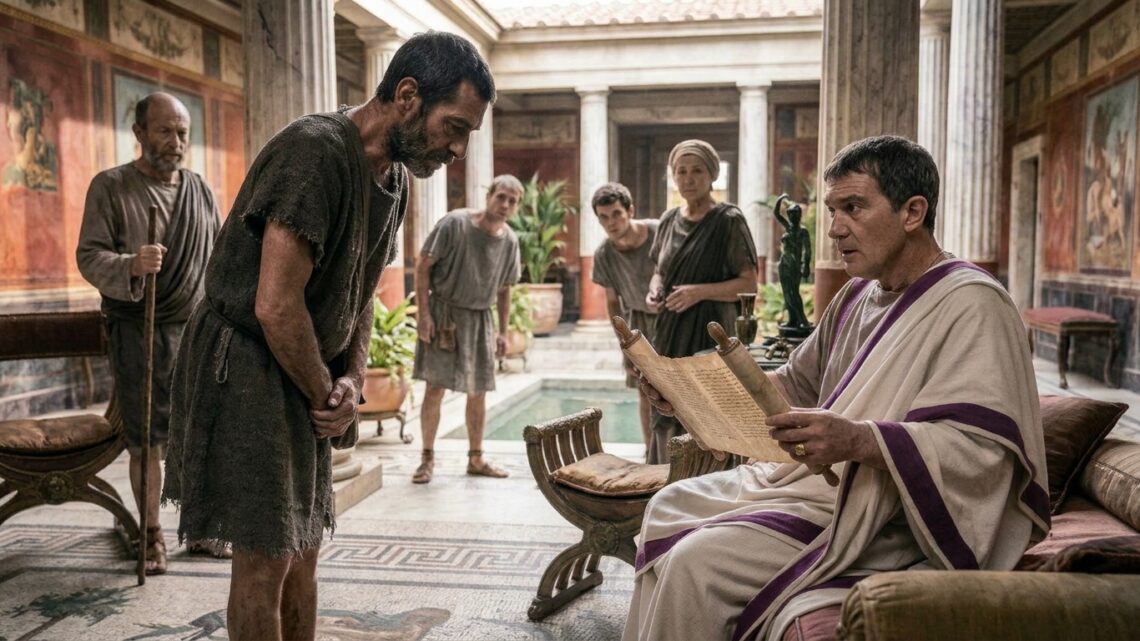
Two couriers arrived at the gates of master Philemon’s villa. Not a remarkable event, usually. In such a large household messengers came and went continually. But these two, word had it, had come all the way from Rome. Sent by the apostle Paul himself, it was said. But that wasn’t what had the household buzzing. How would their master react when he saw who had come. The servants stood breathless, alert, their eyes darting back and forth.
The porter ushered them into Philemon’s office. He looked up. His eyes went wide. Bowing before him stood Onesimus, his runaway slave, holding a scroll.
Philemon took it in hand, reading quickly, glancing up at Onesimus from time to time. Then he reached the lines that would have stopped any Roman cold: “So if you consider me your partner, receive him as you would receive me. If he has wronged you at all, or owes you anything, charge that to my account. I, Paul, write this with my own hand: I will repay it.” (Philemon 17–19)
For most of my life I read this passage as a flourish. A warm, emphatic, slightly theatrical way of saying I mean it.
I pictured Paul taking the pen from his scribe for emphasis. Underlining. The way you might sign a birthday card with an extra exclamation point.
Though my reading sounded right, it missed what any Roman would have seen.
Something a first-century reader would have recognized immediately. In the Roman world, when one person agreed to take on another’s debts, there was a standard way to do it. You wrote it out — in your own hand — and you put your name to it. The document listed what was owed and declared that the writer assumed all those debts as his own..
The legal term for such a document was cheirographon. Literally, “hand-writing.” Cheir is the hand; graph is to write. In practice it meant a bill of indebtedness — a handwritten, signed acknowledgment of debt.
We have something like it. A holographic will is one written entirely in the testator’s own hand. No witnesses, no lawyer. In many places the courts accept it anyway, because the handwriting itself is the proof.
That is what Paul just did.
“Charge that to my account.” “I, Paul, write this with my own hand.” “I will repay it.” Every element is there. Philemon was a wealthy man who did business across the empire. He would not have mistaken it. Neither would anyone listening as the letter was read.
This changes the letter’s whole weight. Paul isn’t only pleading. He is transferring liability. Whatever Onesimus stole, whatever his absence cost, whatever punishment his running deserved — Paul has written it onto his own account. If Philemon wants to collect, he collects from Paul.
And don’t miss who is making the promise. A prisoner. A man with no income, awaiting a verdict that might end his life. He has nothing to pay with but his word and his name. He gives both.
Now notice what Paul does not do. He never names the legal document: the word cheirographon doesn’t appear in that letter. He didn’t need it. You don’t write “this is a signature” under your signature. The act names itself.
The word cheirographon does appear. Once. Only once in the entire New Testament. And it isn’t in the letter to Philemon.
