





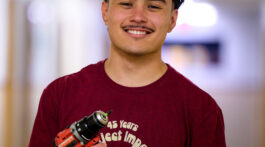






You might assume library work consists mostly of sitting at a desk, reading books and shushing rowdy study groups. That’s what Korbin Peacock, a senior biokinesiology major from Sedalia, Missouri, thought his freshman year as he searched for ways to contribute more toward his tuition.
“I saw one of my buddies working the night shift, and I asked him what he does here, how he likes it, the pros and cons,” Peacock remembered. “He said it’s really, really chill. It’s not super high stress. And when it’s not busy, you can work on your homework. I’m over here thinking, That sounds awesome!”
The next morning, he found Marcia Nordmeyer, the library’s circulation and reference assistant, and applied. Four years later, Peacock has become one of the library’s veteran student employees and, according to Nordmeyer, a champion book shelver.
The opportunities to do homework proved briefer than anticipated. During his employment, the library transitioned from the Dewey Decimal System to Library of Congress Classification, requiring thousands of books to be removed, relabeled and reshelved.
“Korbin was here for all of it!” Nordmeyer said. “While we didn’t track exactly how many books Korbin relabeled, that number is easily in the thousands. He also led the student team in the number of books shelved last school year.”
For Peacock, that productivity is simply part of doing a job well.
“If you’re only doing one or two carts a day, either you’re very new and don’t understand the system or you’re not doing what you’re supposed to be doing,” he said.
Peacock dreams of someday owning a chain of gyms specializing in serving people with neurological and neuromuscular disorders. Already certified as a personal trainer, he has found unexpected connections between his biokinesiology studies and library work.
“The library isn’t just filled with heavy ideas,” Nordmeyer said. “We have heavy-duty shelves, solid wood study carrels and weighty archival boxes. Any time we need something relocated, we can count on Korbin to put his superhuman strength to work.”
Among his recent feats of strength was helping move the shelves in the library further apart to make the aisles wheelchair accessible.
The library has also helped him pursue his long-term goals. During quiet summer shifts, he began exploring the library’s collection for books and articles about training techniques, disabilities and rehabilitation.
“What else are you going to do in the library but find books?” he joked.
Those resources exposed him to different perspectives on exercise and approaches to serving the population he hopes to work with. His library job has also taught him how to work with people and whatever emotions they bring with them — a skill that benefits his personal training clients as well.
“A lot of library work comes down to serving people,” he said. “People need help finding books, searching databases or reserving study rooms. Sometimes they come to you already stressed or angry, and you have to work through their questions and problems with them.”
He especially enjoys questions that require detective work. When the library began lending portable battery packs capable of charging laptops, they proved unexpectedly complicated. Peacock researched how they worked. Soon, his supervisor knew whom to call when anyone had a question.
“I get all excited,” he said. “It’s like, ‘Ooh, I know this one.’”
When Peacock graduates in May, however, he said what he will miss most is not the books, shelving, patrons or paycheck. It will be his supervisor, Nordmeyer.
“I don’t think I could have asked for a better boss, to be honest,” he said. “Marcia is super supportive, very accommodating. She’s the chill part of working in the library.”
Peacock’s career may be heading to the gym rather than the library, but the habits developed through four years of on-campus employment, including hard work, initiative, clear communication and life-long learning, will go with him.
Scott Cushman is director of public relations at Union Adventist University.
