














Paul had a problem in Colossae: teachings that made Christ smaller. Now for the complication.
When we hear “house church,” we picture a living room. Three bedrooms, two baths, folding chairs. A Roman household was something else. A wealthy man’s home was often a villa — several buildings around a courtyard, family, clients, servants, and slaves all under one roof and one master.
The church at Colossae met in such a household. It belonged to a man named Philemon.
Paul had never been to Colossae. But he knew Philemon. Wealthy men traveled the empire, and Paul had covered much of Asia Minor on foot. Somewhere their roads crossed, and Philemon came to faith through Paul. Paul says so, gently but plainly: “you owe me even your own self” (Philemon 19).
So far, simple. Paul writes to the church in his friend’s house.
Except for Onesimus. Onesimus, the runaway slave, stood next to Paul in Rome.
And Onesimus was Philemon’s slave. He had run from the very household that was the destination of the two letters. It may be he stole something on the way out — Paul hints at that. He made for Rome, as many runaways did. The busy roads on the way and a city of a million people provided easy cover for a fugitive.
Somewhere in that crowd, God brought Onesimus and Paul together. The runaway became a believer and then a constant companion, bringing food, running errands, seeing to the needs of a man in chains. A prisoner under guard paid his own way, and depended on friends to care for him.
Now put yourself in Paul’s place. You must write to a church that meets in Philemon’s house. That letter will be read aloud in Philemon’s courtyard, with Philemon—and everyone else—listening. And the man who ran away from that courtyard stands next to you, holding your cup.
You cannot write that letter and say nothing about Onesimus.
And this involved more than just social awkwardness. Rome’s economy ran on slaves, so Rome took runaways seriously. A runaway might be beaten, branded, or even crucified. Roman law left the choice to the master. Philemon, and he alone, would settle what happened to Onesimus.
So Paul has two letters to write. One to save a church from error. One to save a man’s life.
Which do you write first?
We can’t prove the order. Neither letter hints at which Paul wrote first. We do know that both letters went out together, and both name the same people around Paul. Weighing theology with long-term effects versus a fellow-believer under imminent threat, I’d write the one about Onesimus. I’d want to do everything I could to see that Philemon received him gently.
Whatever the order, Paul wrote to Philemon. It is one of the most personal, one of the most vulnerable of all Paul’s letters we have. In that letter he had done something the modern reader passes over, but the Roman world could not miss.
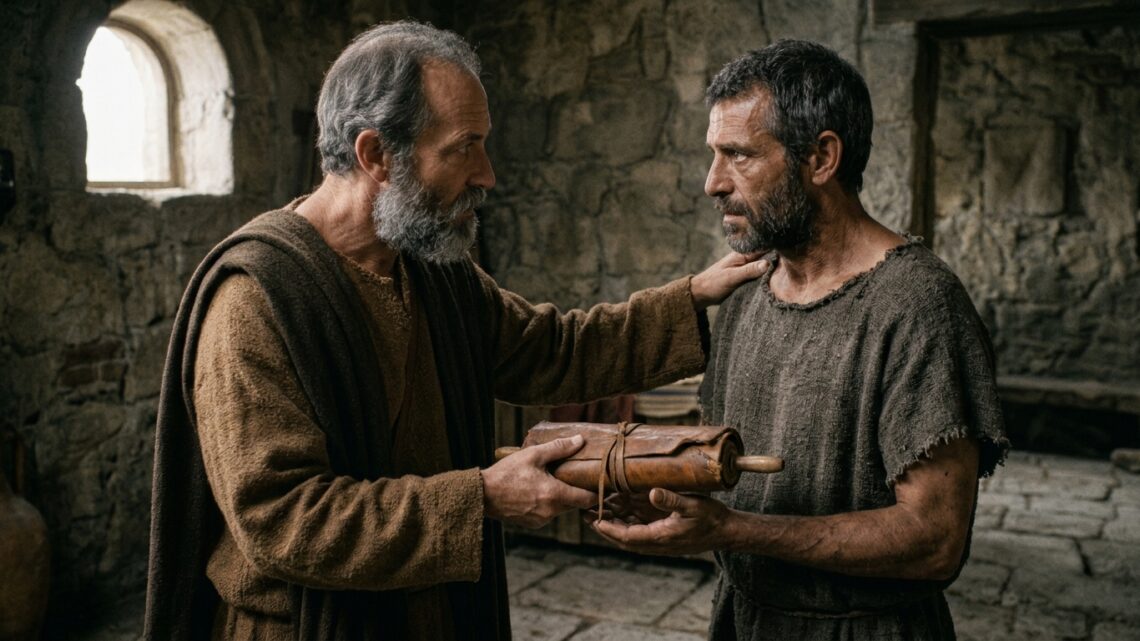
When Paul finished the letter, he handed it to Onesimus.
